RV slide-out failure is the single most common source of high-cost repair bills across both travel trailers and fifth wheels, and the majority of those failures are preventable with a consistent maintenance schedule that most owners skip entirely. Across Indiana RV dealers and service centers, slide-related repairs represent a disproportionate share of service department workload, not because slide systems are inherently unreliable, but because they require regular attention that owners do not always know to provide. This guide covers exactly why slides fail, how to maintain them correctly based on system type, and the decision framework for knowing when you can handle it yourself and when a certified technician needs to be involved.
Why Slide-Outs Fail: The Four Root Causes Behind Most Repair Events
Understanding why slides fail is more useful than a generic maintenance checklist, because it lets you identify which failure mode your unit is most vulnerable to and address it proactively rather than reactively.
Cause One: Seal and Wiper Blade Deterioration
The seals and wiper blades surrounding a slide-out are its primary defense against water intrusion, air infiltration, and debris entry. They are also the first component to degrade, and their degradation is a direct consequence of UV exposure, ozone, temperature cycling, and the mechanical friction of every extend-and-retract cycle the slide completes.
Deteriorated seals do not fail catastrophically in most cases. They fail gradually, which is exactly what makes them dangerous from a damage-accumulation standpoint. A seal that has lost its compression allows moisture to enter in small amounts across dozens of camping trips before a visible water stain or soft floor reveals the problem. By the time the symptom is obvious, the damage has typically extended well beyond what a seal replacement alone can address.
The correct maintenance response is inspection before deterioration, not replacement after failure. Inspect every slide seal and wiper blade at the start of each season and again at the end. Look for cracking, loss of flexibility, compression failure, and separation from the mounting surface. A seal that shows any of those characteristics should be replaced immediately rather than monitored for another season.
Cause Two: Improper Lubrication of Slide Mechanisms and Rails
Slide mechanisms require lubrication to operate smoothly, and the type of lubricant matters as much as whether lubrication is applied at all. This is where a significant number of well-intentioned owners create the problem they are trying to prevent.
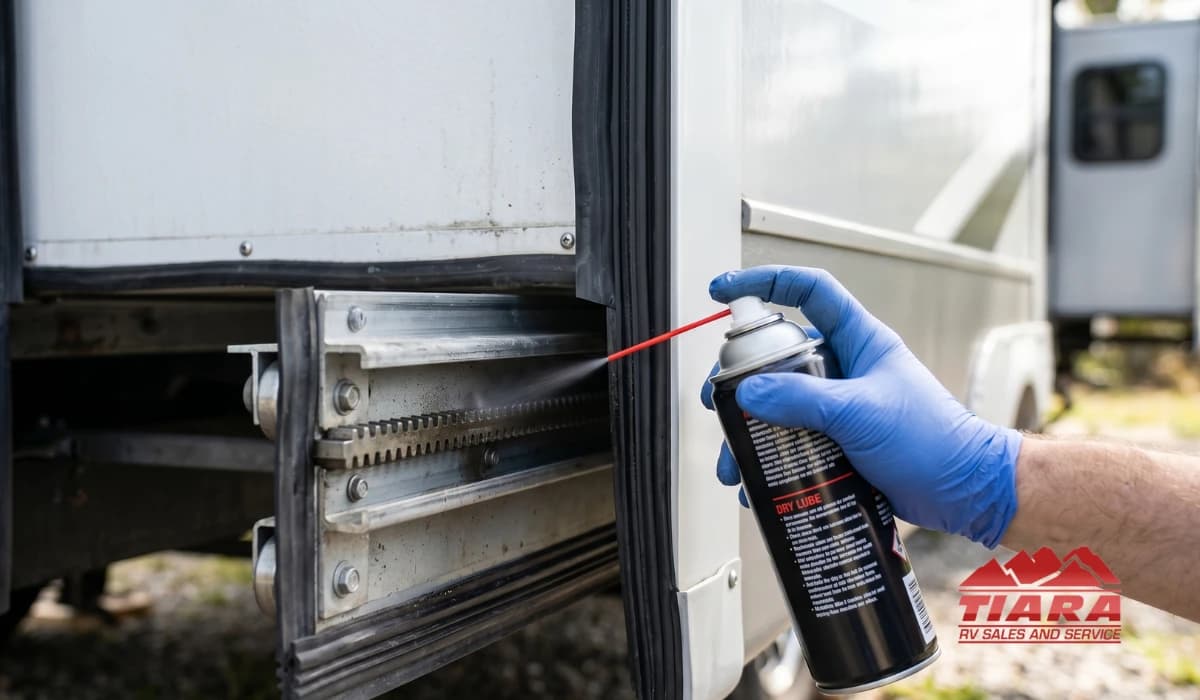
Most Keystone and other major manufacturer slide systems specify a dry lubricant on the slide rails and gears, typically a PTFE-based dry spray or a silicone-based product that does not attract debris. Petroleum-based lubricants like WD-40 or standard grease attract and hold dust, dirt, and road grime, which then acts as an abrasive compound on the gear teeth and rail surfaces during every operating cycle. The result is accelerated wear on components that are expensive to replace.
Check your unit's owner's manual for the specific lubricant type and application points specified by the manufacturer. Apply per the schedule recommended — typically at the start of each season and every three to four months for full-timers. Wiper blade seals should be treated with a rubber conditioner that maintains flexibility without degrading the seal material. Silicone-based rubber conditioners are appropriate for most slide seal materials; petroleum-based products are not.
Cause Three: Motor and Control System Overload on Electric Slides
Electric slide motors are designed to operate within a specific load range. When a slide is operated while the unit is not level, when debris is lodged in the rail or mechanism, or when the slide is overloaded with more weight than the system is rated for, the motor draws excess current to compensate. Repeated overload events shorten motor life significantly and can damage the control board that governs slide operation.
The prevention discipline here is straightforward but requires consistent habit. Always level the unit before extending or retracting slides. Never store heavy items on a slide floor that exceeds the slide's weight rating, residential refrigerators, full water tanks staged on a slide, or heavy furniture positioned at the outer edge all create load conditions the motor was not designed to sustain. Clear any visible debris from the slide track before operating, particularly after driving on gravel roads or through construction areas.
If an electric slide hesitates, moves slower than normal, or requires multiple attempts to complete its travel, those are early warning signs of motor strain. Addressing them at that stage is a maintenance event. Ignoring them until the slide stops mid-travel is a service event that typically involves motor replacement and potentially control board diagnosis.
Cause Four: Hydraulic System Fluid and Seal Degradation
Fifth wheels and larger travel trailers with hydraulic slide systems have an additional maintenance requirement that electric-slide owners do not: hydraulic fluid level and quality management. Hydraulic slides operate on a pressurized fluid system that actuates rams to extend and retract the slide room. When fluid levels drop due to a slow leak, or when fluid degrades from heat cycling over multiple seasons, the system loses pressure and slide operation becomes inconsistent or fails entirely.
Check hydraulic fluid levels at the start of each season using the reservoir inspection point specified in your owner's manual. Use only the fluid type specified by the system manufacturer, most hydraulic slide systems use a specific hydraulic jack oil or automatic transmission fluid depending on the manufacturer's specification. Mixing fluid types or using a substitute degrades seal performance and accelerates wear.
Any hydraulic system that is losing fluid has a leak somewhere in the circuit. Low fluid is a symptom, not the problem. Topping off the reservoir without finding and repairing the leak source is a temporary measure that delays a larger repair event rather than preventing it.
The Correct Maintenance Schedule: Electric vs. Hydraulic Systems
| Task | Electric Slides | Hydraulic Slides |
|---|---|---|
| Seal and wiper inspection | Start and end of each season | Start and end of each season |
| Rail and gear lubrication | Seasonally; every 3–4 months for full-timers | Seasonally; rams and seals per manufacturer spec |
| Fluid level check | Not applicable | Start of each season; inspect for leaks monthly |
| Motor and control board inspection | Annually or at first sign of hesitation | Not applicable in same form |
| Rubber conditioner on seals | Every 90 days during active use | Every 90 days during active use |
DIY vs. Professional Service: Where the Line Is and Why It Matters
Seal inspection and conditioning, rail lubrication, fluid level checks, and debris clearing are all within reach of an owner with basic mechanical comfort and the right products. These are maintenance tasks, not repair tasks, and doing them consistently is the single most effective way to avoid the repair scenarios that follow.
The professional service threshold arrives when the slide system shows functional abnormality rather than maintenance need. Specifically:
- A slide that binds, hesitates, or requires more than one attempt to complete travel
- Any visible fluid leak in a hydraulic system
- A slide that is no longer seating flush with the sidewall when retracted
- Any grinding, clicking, or irregular sound during operation
- A control board error code or unresponsive slide controller
The cost differential between early professional intervention and delayed intervention is substantial. A slide that binds and is diagnosed and corrected at the binding stage typically involves a mechanism adjustment, rail cleaning, and possibly a wiper blade replacement. The same slide that is forced through binding operation until a gear strips or a motor burns out requires motor replacement, potential control board replacement, and in some cases structural realignment of the slide box itself. The maintenance investment is small. The deferred repair is not.
Our RV service department handles slide-out diagnostics, seal replacements, motor service, and hydraulic system repairs on all major brands. If you need lubricants, rubber conditioners, or slide seal products to complete your own maintenance, our RV parts department carries the products specified for Keystone and other major manufacturer systems. If slide issues or deferred maintenance have you thinking about a unit upgrade, our trade-in appraisal process can be started online before you visit.
Frequently Asked Questions
How often should I lubricate my RV slide-out?
For electric slide systems, lubricate the rails and gear mechanisms at the start of each camping season and every three to four months if you are a full-timer or heavy user. Apply rubber conditioner to wiper blade seals every 90 days during active use. Always use the lubricant type specified by your manufacturer — dry PTFE or silicone-based products on gears and rails, silicone-based rubber conditioner on seals. Petroleum-based lubricants attract debris and accelerate wear on slide components.
What causes an RV slide-out to stop working?
The four most common causes of slide-out failure are: seal and wiper blade deterioration allowing moisture intrusion into the mechanism or structure; improper lubrication causing debris accumulation and accelerated gear wear; motor overload from operating the slide while unlevel or with excess weight on the slide floor; and hydraulic fluid loss or degradation in hydraulic slide systems. Most of these failures are preventable with a consistent seasonal maintenance routine.
Can I fix an RV slide-out myself?
Routine maintenance tasks, seal inspection and conditioning, rail lubrication, debris clearing, and fluid level checks on hydraulic systems, are DIY-appropriate for owners with basic mechanical comfort. Functional failures including binding, grinding, motor hesitation, fluid leaks, or misalignment require professional diagnosis by a certified RV technician. Attempting to force a binding slide or continue operating a system showing early failure symptoms accelerates damage and significantly increases repair cost.
How do I know if my RV slide seals need to be replaced?
Inspect slide seals and wiper blades visually at the start and end of each season. Signs that replacement is needed include visible cracking or brittleness in the seal material, loss of compression when the slide is retracted, separation of the seal from its mounting track, and any soft spots or water staining on the interior wall or floor adjacent to the slide. Do not wait for active water intrusion to confirm seal failure — by that point, the damage has already begun accumulating behind the wall.