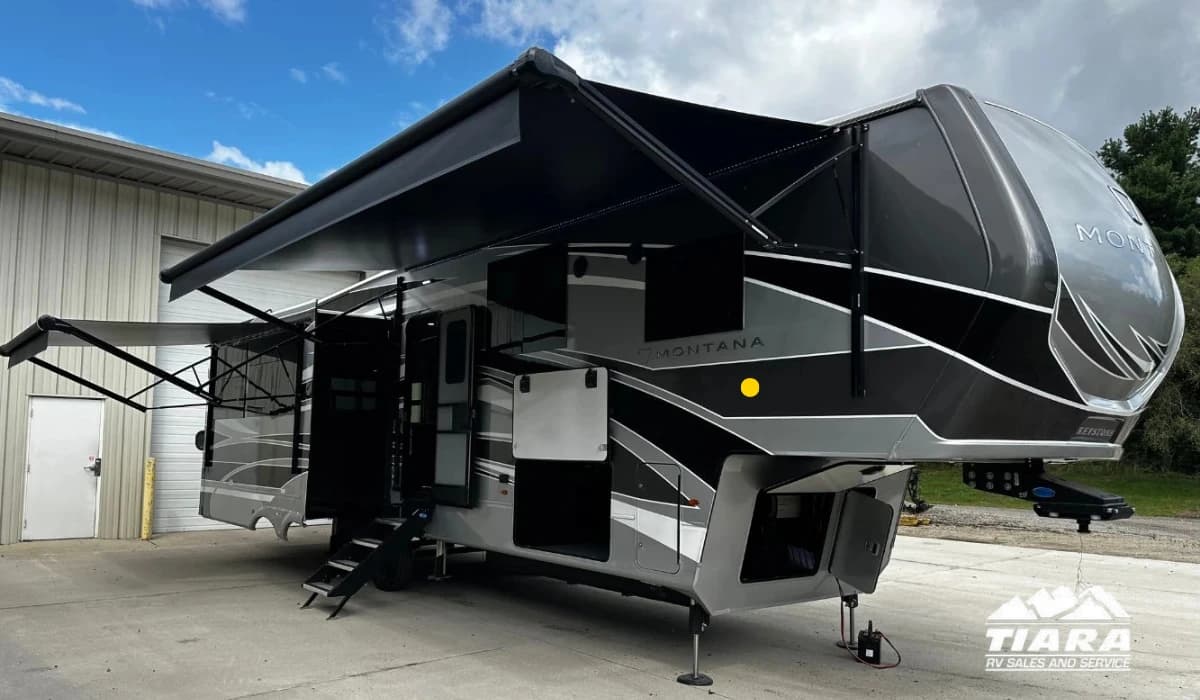
The Keystone Montana is one of the best-selling fifth wheel lines in North America, built on a fully welded steel frame with laminated wall construction that places it above entry-level and mid-tier competitors in structural durability and long-term ownership value. For buyers who have narrowed their search to premium fifth wheels but are still deciding whether the Montana is the right fit for their lifestyle, budget, and tow vehicle, this guide covers what actually defines the Montana line, how its floorplan philosophy differs from competing brands, and what the resale and ownership data tells you about its value over time.
What Makes the Keystone Montana Different from Mid-Tier and Entry-Level Fifth Wheels
The RV market is full of units that look similar from the outside and feel similar on a showroom walk-through. The differences that determine whether a unit holds up over five years of real use are not visible in the finish or the upholstery; they are in the frame, the wall construction, the slide system, and the hardware. The Montana is consistently one of the few fifth wheel lines where those structural differences are measurable and meaningful.
Frame Construction and Structural Standard
The Montana's fully welded steel frame is one of the defining characteristics that separates it from entry-level competitors. Welded frames distribute stress more evenly across the structure than bolted or riveted assemblies, which matters most during towing on uneven roads and when a unit is used heavily over multiple seasons. The frame's geometry is also engineered to support the weight of full-slide configurations without the flex that lighter-gauge frames exhibit under load.
Wall construction in the Montana uses a laminated panel process that bonds the exterior fiberglass skin, insulation layer, and interior wall surface into a single structural panel. That lamination process produces a stiffer, better-insulated wall than the stick-and-tin construction used in lower-tier units, and it resists the delamination that develops in lower-quality builds when temperature cycling and moisture work on adhesive bonds over time.
Slide System Quality and Hardware Standard
The Montana's slide systems use a gear-and-rack mechanism on most configurations, driven by electric motors rated for the load they are designed to carry. The slide rails, seals, and wiper blade assemblies are built to a standard that exceeds what Keystone uses on its mid-tier Outback and Sprinter lines, and that quality difference shows up in real-world ownership as fewer binding events, longer seal life, and more consistent operation across temperature extremes.
Cabinetry hardware across the Montana line uses residential-grade hinges, drawer slides, and door catches rather than the plastic and lightweight metal components common in entry-level units. After two or three seasons of regular use, the difference between residential-grade hardware and budget hardware becomes obvious to every owner. The Montana's hardware is designed to remain functional and tight through vibration from towing and the thermal cycling that affects all components in a unit used across seasons.
Floorplan Philosophy: Livability Over Maximum Capacity
This is the area where the Montana most clearly distinguishes itself from competing fifth wheel lines at a similar price point, and it is the characteristic that experienced buyers most consistently cite as the reason they chose it over alternatives.
Many fifth wheel manufacturers design layouts to maximize the number of sleeping surfaces and the visual impression of space during a showroom walk-through. Montana floorplans are designed around functional daily use. That distinction shows up in specific decisions: kitchen layouts where two people can work simultaneously, living areas with slide coverage that creates a real floor footprint rather than a narrow corridor, and bedroom configurations with genuine wardrobe storage rather than overhead bins that require a step stool for daily access.
The practical effect is that Montana owners report a higher satisfaction rate with their floorplan after two to three years of ownership than owners of competing units purchased at the same price. The unit that impressed on a Saturday afternoon walk-through is not always the unit that works well on a Tuesday morning when two people are getting ready, making coffee, and finding gear — and the Montana's design philosophy accounts for that reality.
Who the Montana Is Built For
Understanding who the Montana serves well is as important as understanding its construction. The Montana is not a one-size-fits-all product; it is a well-defined fifth wheel for a specific buyer profile.
The Montana works best for buyers who camp frequently, four or more weeks per year, and who plan to own the unit for five or more years. At that use level and ownership duration, the construction quality, hardware standard, and floorplan functionality produce a measurably better experience than what a mid-tier unit delivers over the same period. The cost-per-use calculation over a five-year window consistently favors the Montana over a cheaper unit that requires more repairs, produces more friction in daily use, and depreciates to a lower resale floor.
For buyers who camp two or three weekends per year and plan to trade within three years, the Montana's premium may not fully pay back. That buyer may be better served by an Outback or a comparable mid-tier unit. The Montana is the right choice when the ownership window and use intensity justify the construction standard.
Value Retention: What the Resale Data Shows
The Keystone Montana line consistently holds resale value better than most fifth wheels in its purchase price tier. Several factors drive that performance.
First, brand recognition: the Montana name carries strong buyer demand in the used market from owners who have researched the line and specifically want it. Second, construction durability: units that were properly maintained show less wear at the three-to-five-year mark than competing builds, which means the used buyer is getting a unit that still performs close to its original standard. Third, floorplan demand: the Montana's livability-focused layouts remain desirable to used buyers for the same reasons they appeal to new buyers.
The practical implication for new buyers is that the depreciation curve on a Montana is less steep than on entry-level and mid-tier alternatives. A buyer who purchases a Montana and maintains it properly will recover more of their initial investment at resale than a buyer who purchased a cheaper unit at a lower entry price. Over a five-to-seven-year ownership window, that difference in residual value is a meaningful component of the total cost of ownership calculation.
Browse our current inventory of new Keystone Montana fifth wheels at Tiara RV, or explore our full selection of new fifth wheels across all brands and price points. If you have a unit to trade or want to explore a pre-owned Montana, our used Keystone fifth wheel inventory is updated regularly with documented, inspected units.
Frequently Asked Questions
Is the Keystone Montana a good fifth wheel?
Yes, for buyers who camp frequently and plan to own their unit for five or more years. The Montana's fully welded steel frame, laminated wall construction, residential-grade hardware, and livability-focused floorplan philosophy place it consistently above mid-tier and entry-level fifth wheels in structural durability, daily usability, and long-term value retention. It is not the cheapest option in the market, but the total cost of ownership over a five-to-seven-year window compares favorably to lower-priced alternatives when repair frequency and resale value are included in the calculation.
How does the Keystone Montana compare to other fifth wheels in its price range?
The Montana's primary differentiators are its fully welded frame, laminated wall construction, and floorplan design philosophy that prioritizes daily functional livability over maximum sleeping capacity. At a comparable purchase price, many competing fifth wheels use lighter frame construction, lower-grade slide hardware, and layouts designed to impress during a showroom walk-through rather than to function well under daily use. The Montana's resale value performance also consistently outperforms most competitors in its tier, which affects the total cost of ownership calculation over a realistic ownership window.
What is the difference between the Keystone Montana and Montana High Country?
The Montana High Country is Keystone's premium fifth wheel line, positioned above the standard Montana with factory-standard upgrades including an enclosed and heated underbelly system for four-season use, deeper insulation throughout, dual-pane windows, and luxury interior finishing including hardwood cabinet doors and premium fixtures. The standard Montana is a well-built, livability-focused unit designed for frequent seasonal campers who do not require year-round cold-climate capability or the High Country's luxury appointment level. Both lines share the same core structural philosophy but serve different use cases and buyer profiles.
Does the Keystone Montana hold its value?
Yes. The Montana consistently holds resale value better than most fifth wheels in its purchase price tier, driven by strong brand recognition in the used market, construction durability that keeps units performing close to original standard through proper maintenance, and continued buyer demand for the line's livability-focused floorplan approach. Buyers who maintain their unit with documented service records and address seal and system maintenance proactively recover more of their initial investment at resale than buyers of competing units at similar original purchase prices.