
Choosing a family Keystone travel trailer is not the same decision as choosing one for a couple or a solo traveler. Kids change the math in every direction: sleeping arrangements, bathroom access, gear storage, and how much patience everyone has left at the end of a long drive. The good news is that Keystone builds some of the most family-focused floorplans on the market, and knowing what to prioritize before you walk the lot will save you from buying the wrong unit for how your family actually travels. This guide breaks down the key decisions, the features that genuinely matter for families, and what to look for in a Keystone travel trailer in 2026.
Floorplan Decisions That Make or Break Family Camping Trips
The biggest mistake families make when buying a travel trailer is prioritizing overall length or total sleeping capacity without thinking through how the space actually functions across a three-day weekend. A floorplan that sleeps eight means nothing if six of those people cannot get ready in the morning without a traffic jam in the hallway.
Bunkhouse vs. Standard Floorplan: What Families Actually Need
A bunkhouse floorplan dedicates a defined section of the trailer, typically at the rear, to stacked bunks. This does more than just add sleeping capacity. It gives kids their own zone, which matters more than most parents expect until they have spent a night in a unit where everyone is sleeping in the same open room.
The practical benefits of a bunkhouse layout for families include:
- Kids can be in bed while adults remain in the living area without disturbing them.
- Bunk areas often include a dedicated outlet, USB ports, and sometimes a small TV mount, giving older kids a space to decompress independently.
- The rear bunk zone frequently includes its own entry or a half bath, which eliminates the morning bathroom bottleneck entirely.
A standard floorplan without a bunkhouse is not necessarily a wrong choice for families with one or two younger children who still share a sleeping space with parents. But for families with three or more kids, or kids in different age ranges, a bunkhouse layout is almost always the better long-term investment.
Weight Considerations for Family SUVs and Light-Duty Trucks
This is where family buyers frequently run into trouble, and it is a conversation worth having before you fall in love with a floorplan. Bunkhouse travel trailers tend to run heavier than their single-room counterparts because of the additional structure, extra sleeping surfaces, and the gear families load into them.
Your tow vehicle's capacity is defined by two numbers that must both be respected: the Gross Vehicle Weight Rating (GVWR) of the trailer and your vehicle's tow rating and payload capacity. Most three-quarter-ton trucks handle family bunkhouse trailers without issue. The challenge arises with larger SUVs and half-ton trucks, which are among the most common family tow vehicles in the country.
A few guidelines for family buyers towing with an SUV or half-ton:
- Confirm your vehicle's actual tow rating in the owner's manual or door jamb sticker, not from a general web search. Tow ratings vary by engine, axle ratio, and configuration within the same model year.
- Look at the trailer's Unloaded Vehicle Weight (UVW) and add a realistic estimate of gear, water, and passengers. Most families load 1,000 to 1,500 pounds of real-world gear into a trailer that the spec sheet shows as empty.
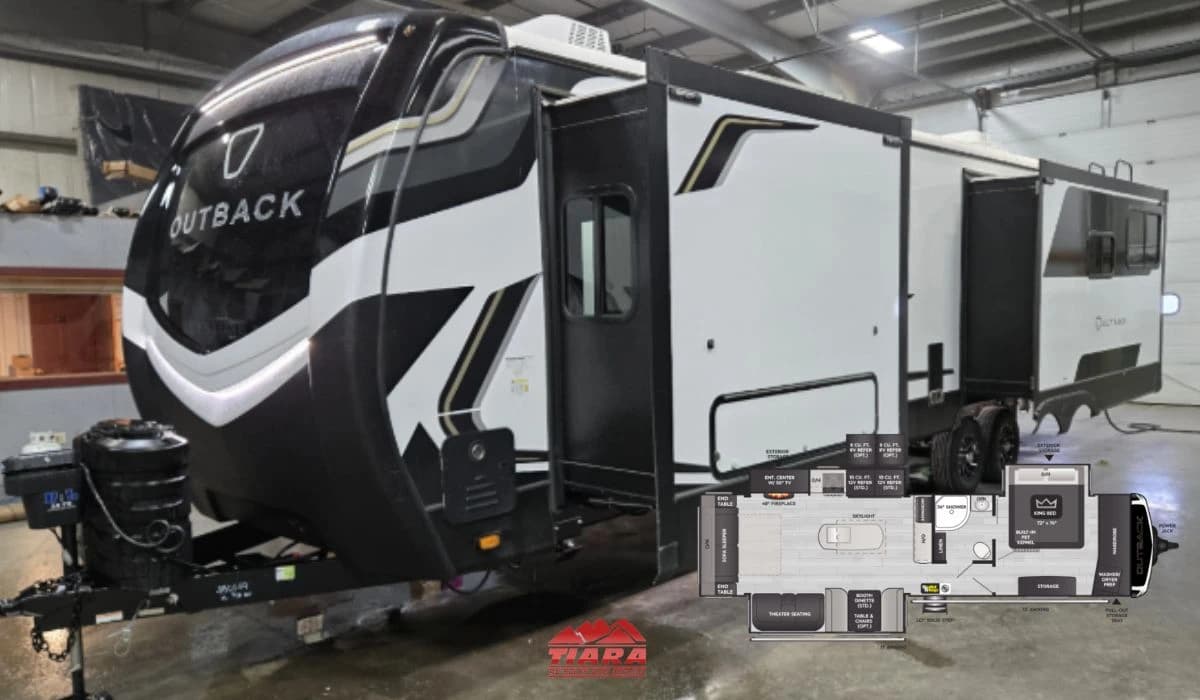
- The Keystone Outback series offers several bunkhouse floorplans engineered with weight-conscious construction that makes them more accessible for half-ton towers without sacrificing the features families need.
If you are unsure whether your vehicle can safely tow the unit you are considering, ask before you buy. Our team at Tiara RV works through this calculation with buyers regularly and can point you toward floorplans that fit your tow vehicle's real-world capacity.
Features That Save Parents' Sanity on the Road
Square footage and sleeping capacity get most of the attention in floorplan comparisons. The features below get less attention in marketing materials but consistently come up when experienced family campers describe what they wish they had prioritized.
Outdoor kitchen. An outdoor kitchen on a travel trailer changes the dynamic of campsite cooking entirely. Keeping food prep outside means less heat and mess inside the unit, more space for kids to move around indoors while meals are being prepared, and a natural gathering point at the campsite that keeps the family in the fresh air instead of crowded around an interior kitchen. Keystone builds outdoor kitchens into several Outback and other family-focused floorplans, typically including a sink, refrigerator or cooler storage, and a cook surface.
Separate bathroom entrance from the bunk area. This feature is underappreciated until 6 AM on day two of a camping trip when three kids need the bathroom at the same time and the only access runs through the master bedroom. Floorplans that route bathroom access from both the main living area and the bunk zone eliminate this problem completely. Look for this specifically when walking any bunkhouse floorplan.
Slide-out in the living area. A slide in the main living area dramatically increases usable floor space when the unit is parked, which is where families spend the majority of their time. Even a single living room slide converts a cramped interior into a space where kids can actually move around, play, or spread out gear without everyone being on top of each other.
Exterior storage compartments. Families travel with more gear than any other camping demographic. Bikes, camp chairs, sports equipment, and outdoor toys need somewhere to go that is not stacked inside the living space. Pass-through storage and dedicated exterior compartments are worth checking on any unit you seriously consider.
Why the Keystone Outback Is Worth a Close Look for Families
The Outback line has built a strong reputation among family campers for combining livable bunkhouse layouts with construction quality that holds up to the heavier use that comes with kids. Features like Keystone's Climate Guard insulation package, residential-style cabinetry, and robust slide-out systems are standard across the line rather than optional add-ons.
Importantly, several Outback bunkhouse floorplans are engineered to stay within the tow capacity of capable half-ton trucks, which makes the line accessible to a wider range of families without requiring a tow vehicle upgrade.
Browse our current selection of new Keystone Outback travel trailers to see available floorplans and configurations. If you want to compare across the full range of family-friendly options, our complete new travel trailer inventory is updated regularly. You can also learn more about how we work with families on the buying process on our About page.
Frequently Asked Questions
What is the best Keystone travel trailer for a family of five?
A bunkhouse floorplan in the Keystone Outback or comparable family-focused line is the most practical choice for a family of five. Look for a layout that provides at least three dedicated sleeping surfaces beyond the master bed, a slide in the living area for daytime space, and bathroom access from both the main area and the bunk zone. Specific floorplan recommendations depend on your tow vehicle capacity and how you plan to use the unit across seasons.
Can a half-ton truck tow a bunkhouse travel trailer?
Yes, in many cases, but it depends on the specific truck configuration and the trailer's loaded weight. Several Keystone bunkhouse models are designed with half-ton towers in mind and stay within a realistic weight range for properly equipped F-150, Ram 1500, or Silverado 1500 trucks. Always verify your truck's actual tow rating and payload capacity against the trailer's GVWR plus realistic loaded weight before purchasing.
Is a bunkhouse travel trailer worth it for younger kids?
For families with children under six or seven who still need parental supervision at night, a bunkhouse layout may be more space than is immediately useful. However, most families find that they grow into the layout quickly, and resale value on bunkhouse floorplans tends to be strong because demand from family buyers remains consistent. If you plan to own the unit for more than two or three years, a bunkhouse is almost always worth the investment.
What should I look for in a family travel trailer outdoor kitchen?
At minimum, a useful outdoor kitchen should include a cook surface, a sink with running water, and either a refrigerator or dedicated cooler storage. Units that add a folding counter extension or a built-in griddle give you meaningfully more usability. Check that the outdoor kitchen is positioned on a side of the unit that does not back directly toward a neighboring campsite, which affects both convenience and courtesy.